Concrete Sidewalk & Walkway Contractor
Front walks, wrap-around sidewalks, side-yard paths, and slab-jacking alternatives. Free written estimates across Dallas–Fort Worth.
Concrete Sidewalk & Walkway Contractor Across Dallas–Fort Worth
A sidewalk looks like the simplest concrete on a property, and it is the one homeowners most often get wrong. It is narrow, which means it has very little mass to resist the clay moving under it, and it usually runs right alongside the foundation, which means a bad slope sends every rainstorm straight at the house instead of away from it. A four-foot walk poured on loose dirt with no joints will crack into random pieces and start lifting within a couple of seasons.
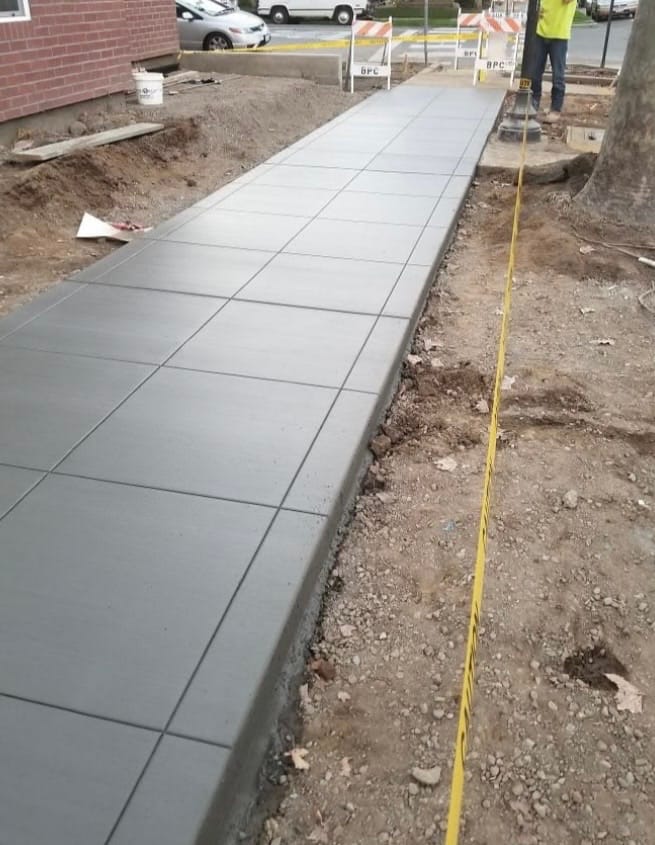
We pour walks the same way we pour driveways, just at a smaller scale: strip the sod and organic material out, compact the subgrade, set forms to a real slope, run reinforcement through it, and cut joints at proper spacing so the panels crack where we tell them to. Where a walk meets the house we hold it slightly low and pitch it away, so the concrete is carrying water off the foundation rather than trapping it against the brick.
The most common call we get is not a new walk at all — it is a walk that has heaved into a trip hazard, usually where a tree root or a plumbing trench runs underneath. Those we cut out and replace panel by panel, which costs a fraction of redoing the whole run.
Wrap-around walks, side-yard runs between the house and the fence, patio connectors, and AC pads all fall under the same crew and the same pricing. Call 972-921-9488 and we will measure it free.
Signs You Need This
- A raised lip between panels you or a visitor has already tripped on
- Water standing on the walk after rain instead of running off
- A walk that pitches toward the house rather than away from it
- Cracked and rocking sections that move when you step on them
- A worn dirt path where a sidewalk should be, especially in the side yard
- Sections lifted by a tree root or settled over a plumbing trench
Concrete Sidewalk & Walkway Contractor Services
Residential and commercial work throughout the Dallas–Fort Worth metroplex. No job too big or too small.
Wrap-Around & Side-Yard Walks
The narrow run between the house and the fence, poured to a consistent width with drainage pitched away from the foundation. Ends the mud path most side yards turn into.
Front Walks & Entry Approaches
Street or driveway to the front door, sized so two people can walk side by side, with steps and landings formed in where the grade calls for them.
Trip-Hazard Panel Replacement
Heaved or sunken sections cut out at the joints and repoured flush. Far cheaper than replacing an entire walk, and it removes the liability.
Patio & Slab Connectors
Short runs tying a patio, shop, shed, or gate to the existing concrete so you are not stepping off onto dirt.
AC, Generator & Equipment Pads
Level pads sized and reinforced for the unit going on them, poured at the same time as the walk when they are on the same side of the house.
ADA & Commercial Walkways
Commercial sidewalk, ramp, and landing work poured to slope and width requirements, including detectable warning surfaces where required.
Our Concrete Sidewalks Process
Free on-site measure
We walk the route with you, check where water currently goes, flag sprinkler heads and shallow utilities, and hand you a written price.
Layout and excavation
Sod and topsoil come out rather than getting buried. Organic material under a slab rots and settles, and a narrow walk shows that settlement immediately.
Base and compaction
Subgrade compacted to a uniform bearing surface. On a walk this matters more than thickness — there is not enough width to bridge a soft spot.
Forms set to slope
Forms staked to line and to a deliberate cross-slope away from the structure. This is the step that decides whether the walk drains or ponds.
Reinforcement and pour
Wire or rebar run through the slab, concrete placed, screeded, and finished with a broom texture for traction when wet.
Joints, cure, and cleanup
Control joints cut at correct spacing, edges tooled, site cleaned, and we tell you exactly when you can walk on it.
Rated 5.0 Across DFW
"We had our back patio done, and it came out EXCELLENT. The quality of the concrete was perfect and the finish on it was perfect as well. Went from barely having a patio to now we have a huge patio in our backyard for events with family and friends. 10/10 recommend."
"Absolutely did a fantastic job on making our backyard perfect! They were prompt with responses, polite, and reasonably priced! We are so thankful for them, and our patio looks beautiful! Very well done, highly recommend!"
"Great company highly recommend does amazing work"
Concrete Sidewalks FAQ
How much does a concrete sidewalk cost in Dallas–Fort Worth?
+
Walks are priced by the square foot, and the variables are width, thickness, how much demo is involved, and how hard the route is to reach with a wheelbarrow or buggy. A tight side yard behind a locked gate costs more to pour than an open front walk of the same size. We measure on site and give you a free written estimate — and if you have a written quote in hand, we will beat it. Call 972-921-9488.
How wide should a sidewalk around a house be?
+
Three feet is the practical minimum and works for a utility run along the side of the house. Four feet is what we recommend for a front walk, because it lets two people pass without stepping off. Commercial and ADA work has its own required widths, which we will confirm for your specific site.
Can you replace just the cracked section instead of the whole walk?
+
Usually yes, and it is normally the right call. If the panels on either side are sound, we saw at the existing joints, break out and haul off the bad section, rebuild the base, and pour a new panel flush with its neighbors. You will see the new concrete for a year or so until it weathers in, but structurally it is a clean repair.
Why does my sidewalk lift up at one end?
+
Almost always one of three things: a tree root growing underneath, expansive clay swelling after a wet spell, or a trench backfilled loosely when someone ran plumbing or irrigation. Grinding the lip down hides the symptom for a while, but if the cause is still under there it will lift again. We will tell you which one you are dealing with.
Should the sidewalk slope away from the house?
+
Yes, always. A walk running along the foundation should pitch away from the structure so rain sheds into the yard. We have re-poured a lot of walks that were set level or sloped back toward the brick, and in North Texas clay that is a slow, expensive way to keep the soil at your foundation wet year-round.
Do you need a permit for a sidewalk?
+
Private walks on your own lot typically do not need one. Work in the public right-of-way — the city sidewalk at the street, or a driveway approach — usually does. We will tell you what your city requires when we come measure.
How long before I can walk on it?
+
Foot traffic is generally fine after about 24 hours, but we will give you the exact window at the pour based on the mix and the weather. Keep pets off it too — paw prints in fresh concrete are permanent.
Concrete Service Across DFW
Related Services
Concrete Driveway Contractor
New driveway pours, tear-out and replacement, widening and extensions — built for North Texas clay.
Concrete Patio Contractor
Backyard patios, extensions, and covered-patio pads — sloped to drain away from your foundation.
Concrete Slab & Add-On Contractor
Shop and shed slabs, patio add-ons, extensions, RV and equipment pads — formed, doweled, and poured to carry real load.
Asphalt Sealcoating
Protect asphalt from Texas sun and water damage. The cheapest way to postpone a full repave.
Parking Lot Striping & Line Marking
Stalls, ADA spaces, fire lanes, and arrows. Layout that maximizes stall count and passes inspection.
Free Concrete Sidewalks Estimates
Mon–Sat, 9am – 5pm · Closed Sunday
Financing available — call and ask about our finance options