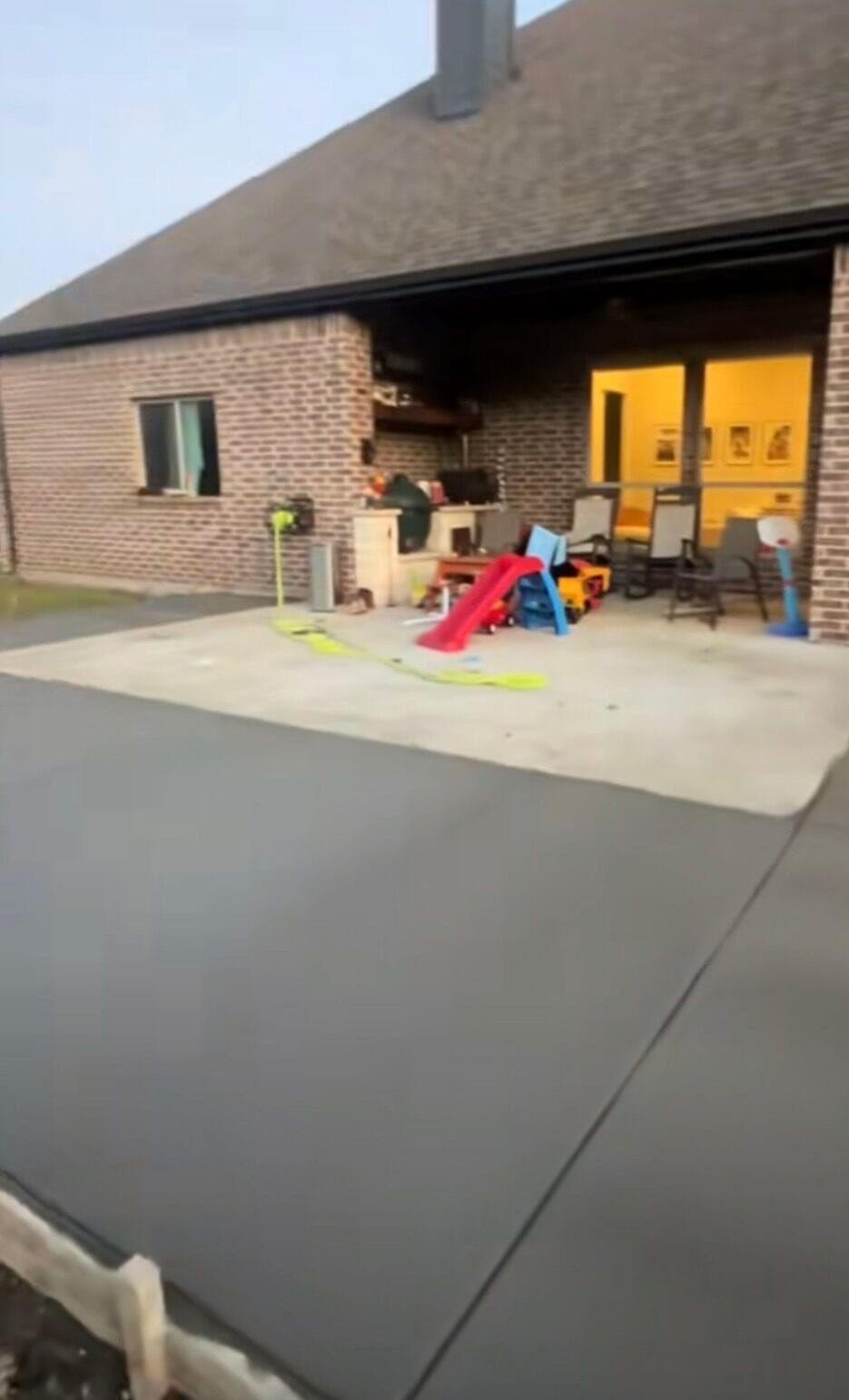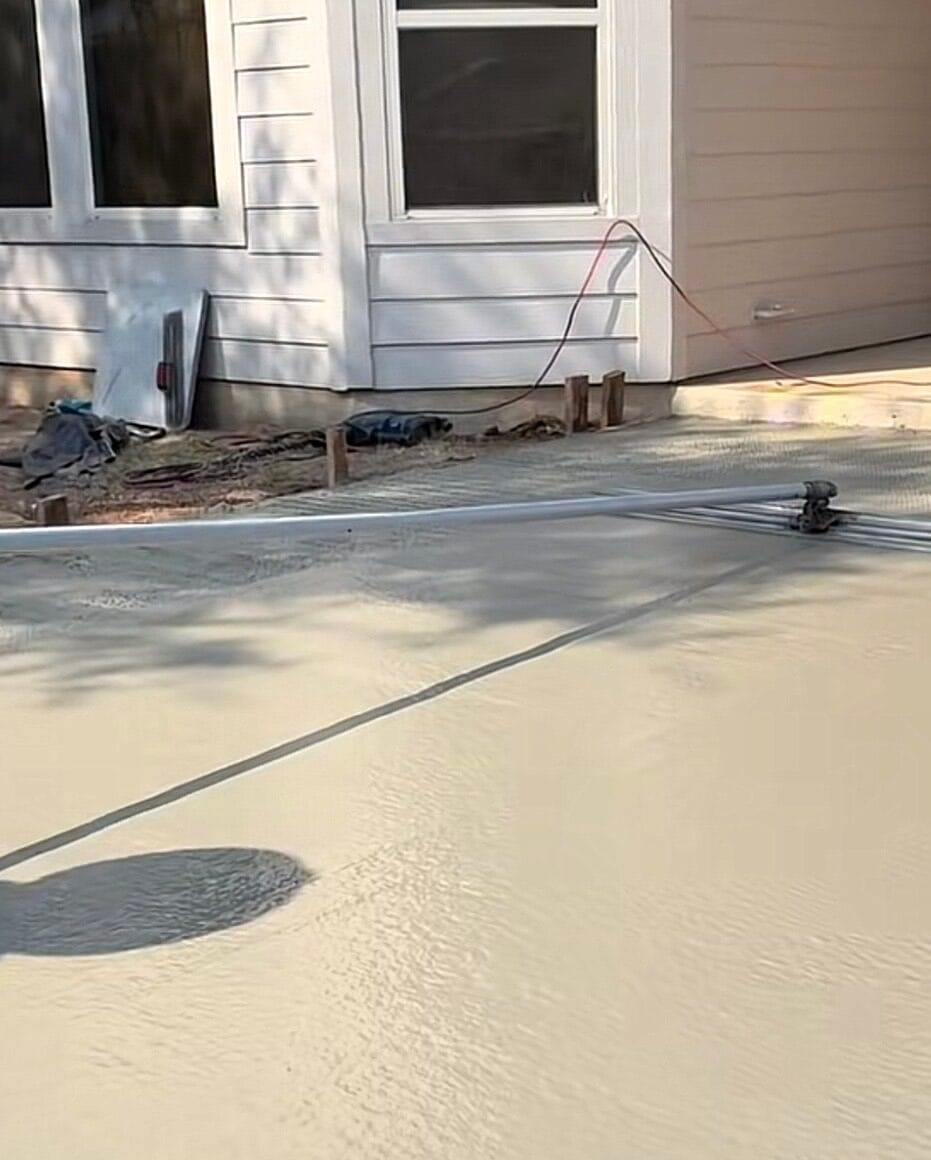
The most common concrete call we get in this metroplex isn't a cracked slab or a new build. It's a house with a driveway built one car wide and a family with two cars in it. Somebody has been parking half on the grass for three years, there's a permanent mud rut where the passenger tire lands, and they've finally had enough. A driveway extension fixes that, and it's a smaller, faster, cheaper job than most people assume before they call.
We've poured extensions recently in Venus, Waxahachie, Glenn Heights and Dallas, and the job is the same shape every time. Here's what's actually involved, so you know what you're buying and what to ask whoever quotes it.
What an extension is, specifically. You're pouring a new strip of concrete alongside your existing driveway — typically 4 to 10 feet wide, running some or all of the length of the drive — so the finished surface reads as one wider driveway rather than two slabs sitting next to each other. Sometimes it runs the full length from the street to the garage. Sometimes it's just a parking pad near the garage, or a strip that continues past the side of the house to a gate or shop out back. All three are the same fundamental job.
Why the tie-in is the whole job. Here's the part that separates a good extension from one that looks wrong in two years, and it's worth understanding before you compare quotes. Your existing driveway has been sitting on North Texas clay for years or decades. It has already done its settling. The new strip hasn't. If the two slabs are simply butted together and left to fight each other, they will move at different rates and you get a lipped seam — one side sitting higher than the other, which catches a tire, collects water, and eventually spalls along the edge.
There are two legitimate ways to handle that. The better one on most residential jobs is doweling: drilling into the edge of the existing slab and epoxying short lengths of rebar that extend into the new pour, so the two slabs are mechanically tied and move together. The other is a deliberate expansion joint — a clean isolation joint with the right filler material, letting the slabs move independently but in a controlled, sealed line rather than a ragged crack. What you do not want is neither. Ask any contractor quoting your extension which of the two they're doing. If the answer is vague, that tells you something.
Base prep on a narrow strip is harder than it looks. An extension is often dug in a tight space, between the existing drive and a flower bed, fence, or side yard. That strip of ground has usually never been compacted, and it's frequently where the downspout has been dumping water for years, which means soft, saturated clay right where you need a stable base. Real prep means excavating to grade, removing any organic material and topsoil, and compacting the subgrade, usually with a few inches of crushed base on top. On the Venus job we set forms and tied a full rebar grid over a compacted base before any concrete came off the truck — that's what the prep stage should look like.
Reinforcement. Fiber mesh is the cheapest option and it's fine for foot traffic. For anything a vehicle parks on in expansive clay soil, you want welded wire at minimum and #3 or #4 rebar on chairs as the real answer. Rebar on chairs matters specifically: the steel has to sit in the middle of the slab thickness to do its job, and steel laid flat on the ground before the pour is decorative, not structural. This is invisible once the concrete is down, which is exactly why it's worth asking about.
Thickness. Four inches is standard for passenger vehicles. If the extension is where you park a work truck, a dually, a trailer, or an RV, that needs to go to five or six inches, and the base beneath it wants to be thicker too. Be honest with your contractor about the heaviest thing that will regularly sit on it. An extension spec'd for a sedan and used as a trailer pad will rut, and that's a specification problem, not a warranty claim.
Drainage, which is the thing people forget. When you widen a driveway you are replacing permeable ground with an impermeable surface, and that water now has to go somewhere. The new strip has to be graded to shed water away from your foundation, not toward it. This matters most when the extension runs along the side of the house, which is exactly where most of them go. If a contractor doesn't walk the grade with you and tell you where the water is going to run, that's a real omission — foundation water problems cost a great deal more to fix than a driveway.
Matching the existing concrete, and managing your expectations. The new pour will not be the same color as your old driveway, and any contractor who promises otherwise is setting you up to be disappointed. Concrete cures to its final color over months and takes on years of weathering, tire marks, and UV exposure. A fresh slab next to a fifteen-year-old slab will read noticeably lighter for the first year or two, then converge considerably. What can be matched well is the finish texture and the control joint pattern — running your new joints to line up with the existing ones is a small detail that makes the finished driveway look intentional rather than patched.
Control joints. Concrete shrinks as it cures and it will crack; joints decide whether that crack lands in a clean planned line or across the middle of your new strip. On a narrow extension, joints typically want to be spaced at roughly two to three times the slab width in feet, and ideally lined up with the joints in the existing driveway. Ask what the joint plan is. A contractor who answers that one without hesitating has poured a lot of these.
How long it takes and when you can drive on it. Most residential extensions are a one-day pour after prep, and prep is typically a half to full day. You can walk on it after about 24 to 48 hours. Passenger vehicles want to stay off for seven days, and heavy vehicles or trailer jacks for a full 28 days, which is when concrete reaches most of its design strength. In a Texas August, keeping the surface damp during the first few days is not optional — fast surface drying in extreme heat is what causes surface crazing and dusting. Any crew pouring in summer should have a curing plan, whether that's wet curing, a curing compound, or both.
What moves the price. Width and length obviously, but also: how much excavation and haul-off the strip requires, whether there's a sidewalk, curb, or apron section that has to be cut and replaced, site access for the truck and whether concrete has to be wheelbarrowed or pumped, thickness and reinforcement spec, whether any drainage work is needed, and the finish. We're not going to print a per-foot number here because an extension along an open side yard and an extension squeezed behind a fence with no truck access aren't the same job. Published 2026 DFW figures for plain gray concrete generally land somewhere in the $5 to $15 per square foot range depending on the source and the spec, which is a wide enough spread to tell you the spec is what matters.
How to compare quotes on an extension. Ask every contractor for the same six things in writing: slab thickness in inches, the PSI of the mix, reinforcement type and spacing, how they're tying into the existing slab, what base prep is included, and whether excavation haul-off is in the price. If one bid comes in dramatically cheaper, one of those six is different — most often it's the tie-in method or the base prep, because those are the two a homeowner can't see once the job is done.
Permits. A driveway extension entirely on your property, not touching the street approach, usually doesn't require a permit in most DFW municipalities, but this genuinely varies city to city and some HOAs have their own rules about driveway width and impervious coverage. If your extension touches the approach between the sidewalk and the street, that section is typically governed by city standards and may need a permit and inspection. Worth confirming before work starts rather than after.
We pour driveway extensions across Dallas, Ellis, Johnson and Tarrant County — Venus, Waxahachie, Midlothian, Glenn Heights, Red Oak, Dallas, Cedar Hill, DeSoto and the rest of the metroplex. We'll come measure it, walk the grade with you, and give you a written estimate that spells out thickness, mix, reinforcement and the tie-in method, so you can hold it up against anybody else's. Free written estimates, and we'll beat any comparable written quote. Call 972-921-9488.
Free Estimate, Same-Day Service
We'll beat any written quote in the metroplex.